Aluminum Wiring Repair & Replacement in St. Louis
If your home was built between 1965 and 1973, it may have aluminum branch circuit wiring, the kind insurers ask about and home inspectors flag. Here's what it is, how the recognized repairs actually compare, and what it means for your insurance and your home's sale, from First Choice Electric, licensed St. Louis electricians since 2010.
What Is Aluminum Branch Wiring?
A cost-driven substitution from the late 1960s that created a connection problem the industry is still repairing today.
The Short History
Why it's in your walls
When copper prices spiked in the mid-1960s, builders switched to aluminum for the branch circuits that feed a home's outlets, switches, and lights. According to the U.S. Consumer Product Safety Commission (CPSC), homes built or added onto between 1965 and 1973 may contain this wiring. Homes built before 1965 are unlikely to have it.
The problem isn't the wire run inside the wall. It's the connections. Aluminum expands and contracts with heat more than copper and its surface oxidizes. Over decades, that loosens and degrades connections at outlets, switches, and splices, raising resistance and creating hot spots exactly where the wire meets a device.
The CPSC's research put a number on it: homes wired with aluminum wire manufactured before 1972 are 55 times more likely to have one or more connections reach fire hazard conditions than homes wired with copper (CPSC Publication 516, “Repairing Aluminum Wiring”).
Warning Signs the CPSC Lists
Aluminum connection failures often show themselves before a fire. The CPSC identifies these indicators of trouble:
- Cover plates on outlets or switches that are warm to the touch
- Flickering lights without an obvious cause
- Circuits that stop working for no apparent reason
- The smell of burning plastic near outlets or switches
Seeing any of these in a 1965–1973 home? Stop using the affected outlets and have the circuit assessed promptly.
Failures Happen Silently, Too
A deteriorating aluminum connection doesn't always announce itself, which is why the CPSC-recognized repairs address every connection point in the home, not just the ones showing symptoms.
How to Tell If Your Home Has Aluminum Wiring
Three checks, from easiest to most reliable.
Check When Your Home Was Built
Per the CPSC, homes built or expanded between 1965 and 1973 may have aluminum branch circuit wiring. Homes built before 1965 are unlikely to have it. Much of St. Louis County and St. Charles County suburban housing dates to exactly this window.
Look at the Cable Markings
Exposed cable in your panel, attic, or basement is printed with the conductor material. Aluminum cable is marked "AL" or "ALUMINUM" every few feet along the sheathing, and the exposed wire itself is silver-colored rather than copper-colored.
Get a Professional Assessment
Don't remove cover plates or open your panel yourself. A licensed electrician can confirm whether your branch circuits are aluminum and assess the condition of the connections. That's where aluminum wiring problems actually happen.
Your Remediation Options, Honestly Compared
The CPSC recognizes three permanent answers to aluminum branch wiring. Here's how they differ, and what doesn't qualify.
Full Copper Rewire
Every aluminum branch circuit is replaced with modern grounded copper. This is the most thorough fix the CPSC lists, since it removes the hazard entirely rather than repairing connections, and it makes sense when your home also needs other electrical updates like a panel replacement or additional circuits.
- Aluminum branch circuits removed, not repaired
- Modern grounded copper throughout
- Best long-term answer for insurance and resale questions
- Most invasive option: some wall access is required
COPALUM Crimp Repair
A short copper wire is joined to each aluminum conductor with a powered crimping tool that creates a permanent cold-weld connection, so every device connects to copper. The CPSC identifies COPALUM crimping as a permanent repair. It requires a specially trained installer with manufacturer tooling, and every connection point in the home is addressed.
- Permanent cold-weld copper-to-aluminum connection
- Every outlet, switch, and fixture connection repaired
- Far less invasive than opening walls for a rewire
- Requires certified installer and special tooling
AlumiConn Connectors
A miniature lug-style connector that joins the aluminum conductor to a copper pigtail with set screws. The CPSC has recognized AlumiConn as an acceptable alternative repair where COPALUM isn't practical. Correct torque on every connector matters, so installation quality determines the result.
- CPSC-recognized alternative to COPALUM
- No proprietary crimping tool required
- Addresses every connection point, like COPALUM
- Quality depends on correct installation and torque
What the CPSC Does Not Recommend
“Pigtailing” aluminum to copper with ordinary twist-on wire connectors overheated in CPSC testing, and CO/ALR-rated switches and outlets are considered an incomplete repair on their own. If a bid proposes either as the entire fix, it isn't a CPSC-recognized remediation, and it's unlikely to satisfy an insurer asking for documentation.
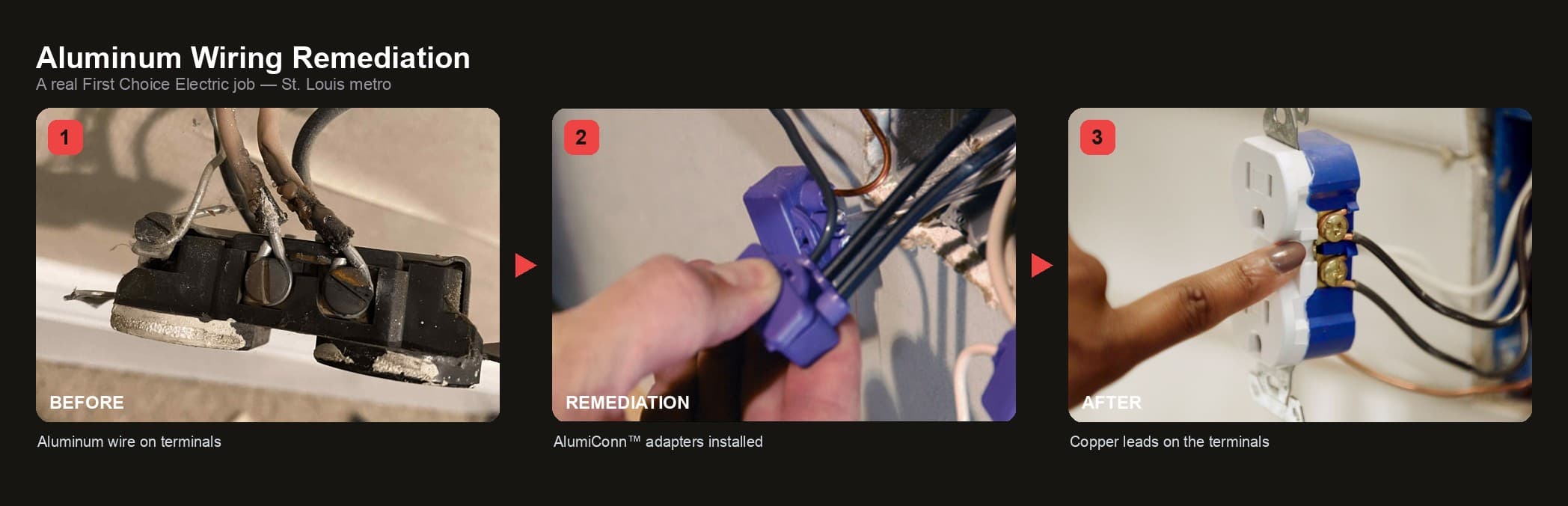
See an Actual Aluminum Repair
A real First Choice Electric job: the original aluminum connections, AlumiConn™ connectors installed at every point, and the finished copper leads on the device terminals.
Will Insurance Cover a House With Aluminum Wiring?
There's no universal rule: it depends on the insurer. But the pattern across the industry is consistent: aluminum branch wiring is treated as an elevated risk. Many insurers ask about wiring type on applications for older homes, and consumer insurance resources report outcomes ranging from declined coverage, to higher premiums, to coverage conditioned on professional remediation.
What moves an insurer from “no” to “yes” is usually the same thing: documented remediation using a recognized repair method, performed by a licensed electrician. That's why the repair method matters beyond safety: a wire-nut pigtail job doesn't produce documentation an underwriter respects.
We can't speak for your insurance company, and you should confirm requirements with your agent. What we can do is perform a CPSC-recognized remediation and hand you the permits, invoices, and method documentation insurers ask for.
What Insurers Commonly Want to See
- Confirmation of the wiring type by a licensed electrician
- Remediation using a recognized method (rewire, COPALUM, or AlumiConn)
- Permits and inspection records for the work
- Dated invoices identifying the repair method used
Shopping for Coverage on an Un-Remediated Home?
Get a written remediation quote first. It converts an unknown into a fixed cost, useful whether you're negotiating with an insurer, a seller, or your own budget.
Request a written quoteBuying or Selling a Home With Aluminum Wiring
Aluminum wiring shows up on inspection reports, not just in insurance applications. Here's how it plays out in a St. Louis home sale, on either side of the table.
Inspectors Flag It
Home inspectors routinely call out aluminum branch wiring in inspection reports, usually with a recommendation for evaluation by a licensed electrician. Expect it to come up in any sale of a 1965–1973 home that hasn't been remediated.
It Becomes a Negotiation Item
Buyers commonly respond to an aluminum wiring finding by requesting remediation before closing or a price credit to cover it. A written quote from a licensed electrician turns an open-ended fear into a concrete number both sides can negotiate around.
Documentation Settles It
If the wiring was already remediated with a CPSC-recognized method, dated documentation from a licensed electrician (permits, invoices, and the method used) is what buyers, agents, and insurers want to see. Keep it with your house records.
Sellers Have Two Good Paths
Remediate before listing and market the home with documentation in hand, or disclose and negotiate. Either works. What hurts sales is an undisclosed surprise on the inspection report with no plan attached.
Aluminum Wiring FAQ
The questions St. Louis homeowners, buyers, and sellers actually ask about aluminum wiring.
How do I know if my house has aluminum wiring?+
Check two things: age and markings. Per the CPSC, homes built or expanded between 1965 and 1973 may have aluminum branch circuit wiring. Exposed cable in the panel area, attic, or basement is printed "AL" or "ALUMINUM" along the sheathing, and the exposed conductor is silver-colored instead of copper. If you're unsure, a licensed electrician can confirm it during an assessment. Don't open the panel yourself.
Will insurance cover a house with aluminum wiring?+
It varies by company, so there's no single answer. Many insurers treat aluminum branch wiring as an elevated risk: some decline coverage until it's addressed, some charge higher premiums, and many will insure the home once remediation with a recognized repair method is documented. The practical takeaway for St. Louis homeowners: get the wiring remediated by a licensed electrician, keep the permit and repair documentation, and share it with your insurer.
Is aluminum wiring illegal? Do I have to remove it?+
No. Aluminum branch wiring that was installed to code in the 1960s and 70s is generally grandfathered: there's no law requiring you to remove it. The issue is risk, not legality: the CPSC found that homes wired with pre-1972 aluminum wire are 55 times more likely to have one or more connections reach fire hazard conditions than copper-wired homes. That risk is also why insurers and home buyers pay attention to it.
What is COPALUM crimping?+
COPALUM is a repair system that joins a copper pigtail to each aluminum conductor using a powered crimping tool, creating a permanent cold-weld connection. Every outlet, switch, and fixture connection in the home is repaired so devices connect to copper instead of aluminum. The CPSC identifies COPALUM crimping as a permanent repair for aluminum wiring. It must be installed by a specially trained electrician with the manufacturer's tooling.
Is pigtailing with regular wire nuts a safe fix?+
The CPSC does not recommend it. In CPSC testing, pigtail connections made with ordinary twist-on connectors overheated, and the agency also considers CO/ALR-rated switches and outlets an incomplete repair on their own. The repairs the CPSC recognizes are a full copper rewire, COPALUM crimping, or AlumiConn connectors. If a contractor proposes ordinary wire-nut pigtailing as the whole fix, get another opinion.
Should I repair the connections or fully rewire?+
It depends on the rest of your electrical system. If the wiring itself is in good condition and the home doesn't need other electrical work, a CPSC-recognized connection repair (COPALUM or AlumiConn) addresses the hazard with far less disruption. If your home also needs a panel replacement, added circuits, or has mixed wiring eras, a full copper rewire can make more sense as one project. We quote both approaches so you can compare them directly.
Does aluminum wiring affect selling my home?+
It usually comes up, but it doesn't have to derail a sale. Inspectors flag aluminum branch wiring on 1965–1973 homes, and buyers typically respond by asking for remediation or a credit. Sellers who remediate before listing, or who disclose it with a written repair quote attached, keep control of the negotiation. Documented remediation with permits is the cleanest outcome for both sides.
Which St. Louis area homes have aluminum wiring?+
Any home built or expanded during the 1965–1973 window is a candidate; that's the era the CPSC identifies. In the St. Louis metro, that includes large parts of the postwar suburban growth in St. Louis County and St. Charles County. The year built is a starting point, not a verdict: the only way to know is to check the cable markings or have a licensed electrician confirm it.
Get a Straight Answer on Your Aluminum Wiring
Free assessment, a written quote for both repair and rewire options, and the documentation your insurer or buyer will ask for. First Choice Electric responds within 24 hours.
Keep Reading
Knob-and-Tube Wiring Guide
Pre-1940s home? The other wiring type insurers and inspectors flag, and St. Louis has one of the oldest housing stocks in the country.
Whole-Home Rewiring
What a full copper rewire involves: process, timeline, permits, and what's included.
Rewiring Cost Guide
Typical St. Louis price ranges and the factors that move your quote up or down.